

















Backgammon is one of the oldest board games in the world, dating back over 5,000 years. It's a game of strategy and luck played between two players on a board with 24 narrow triangles called points. If you've never played before, don't worry — this guide will walk you through everything you need to know.
What is Backgammon?
Backgammon is a two-player board game where each player has 15 checkers (also called stones or men) that move between 24 triangular points according to the roll of two dice.
The objective is simple: be the first to move all your checkers around the board and bear them off (remove them). While dice determine how far you move, strategy determines which checkers you move and when.
It combines elements of strategy and probability, making every game unique. Whether you play casually or competitively, backgammon offers deep tactical challenges wrapped in an accessible format.
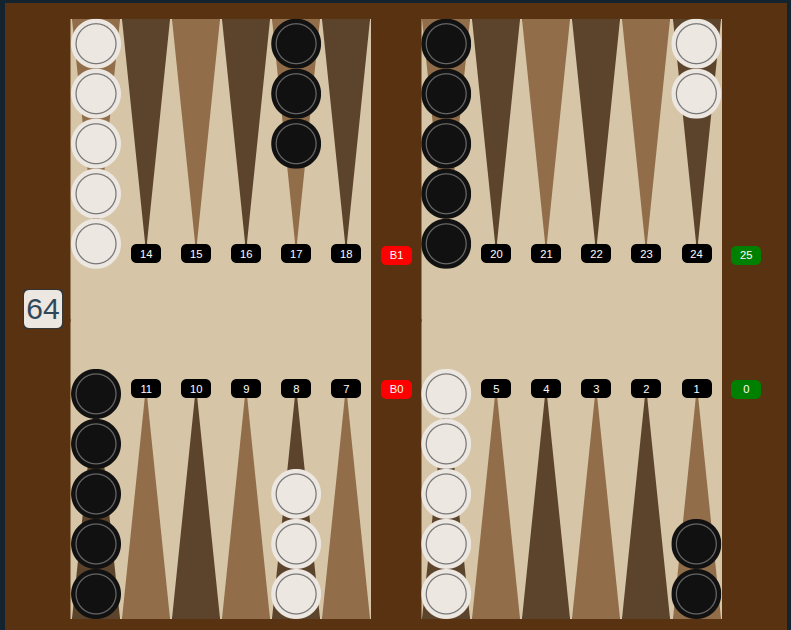
The Board and Initial Setup
The backgammon board has 24 narrow triangles called points, numbered 1 through 24. The points are grouped into four quadrants of six points each:
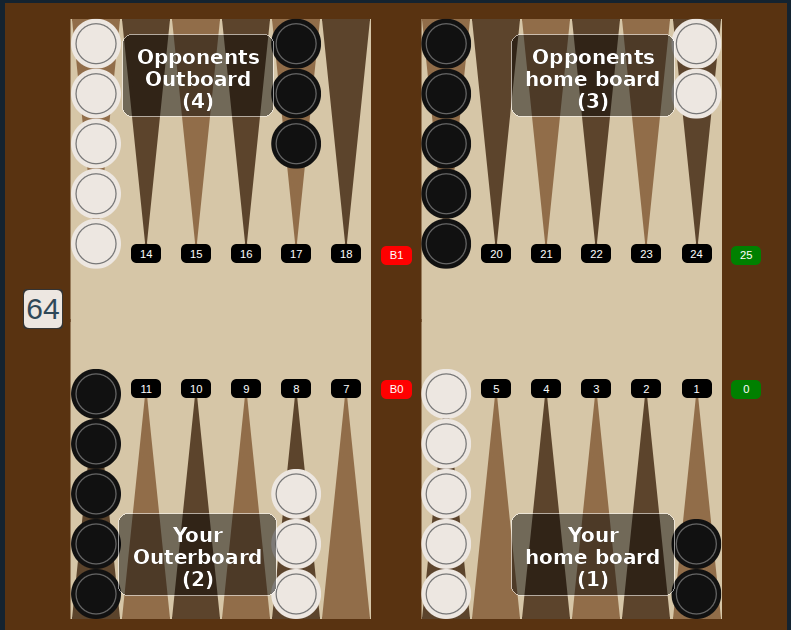
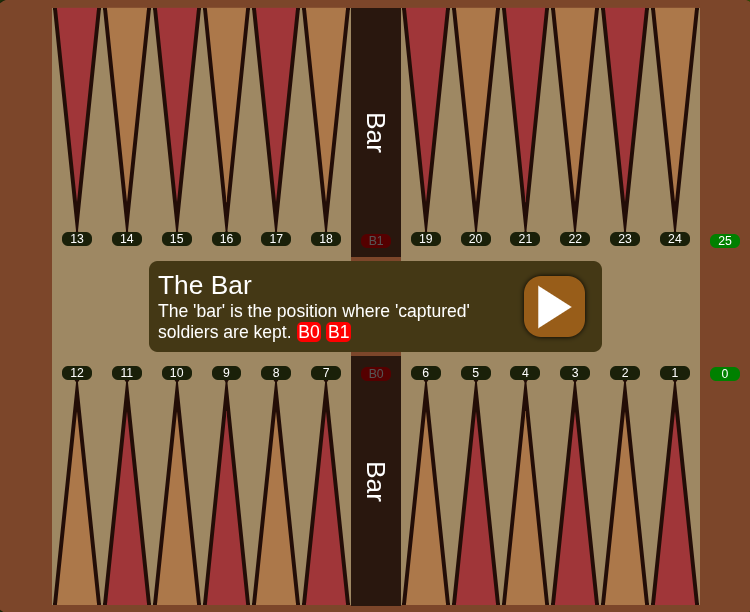
A raised bar divides the board in half. The bar holds captured checkers waiting to re-enter the game.
Each player starts with 15 checkers arranged in a specific pattern:
- 2 checkers on point 24
- 5 checkers on point 13
- 3 checkers on point 8
- 5 checkers on point 6
Your opponent's checkers mirror this arrangement from their perspective. Both players move in opposite directions around the board toward their respective home boards.
How to Move Your Checkers
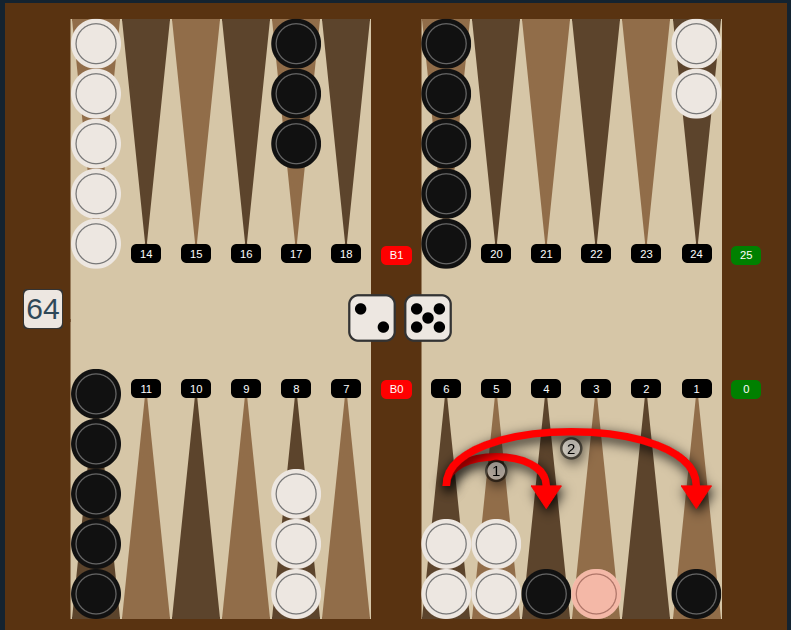
On each turn, you roll two dice and move your checkers accordingly. The key rules are:
Each die represents a separate move. You can move one checker the total of both dice, or move two different checkers one die each.
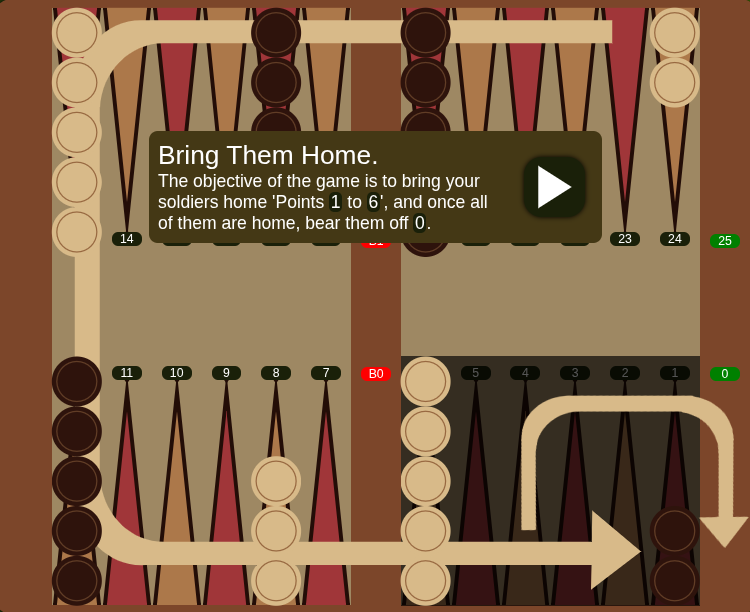
Checkers always move forward (toward your home board), from higher-numbered points to lower-numbered points.
You can only land on open points — those that are not occupied by two or more of your opponent's checkers.
If you roll doubles (e.g., 3-3), you get four moves of that number instead of two.
You must use both dice numbers if legally possible. If you can only play one, you must play the higher one. If neither can be played, your turn is skipped.
Hitting and Entering
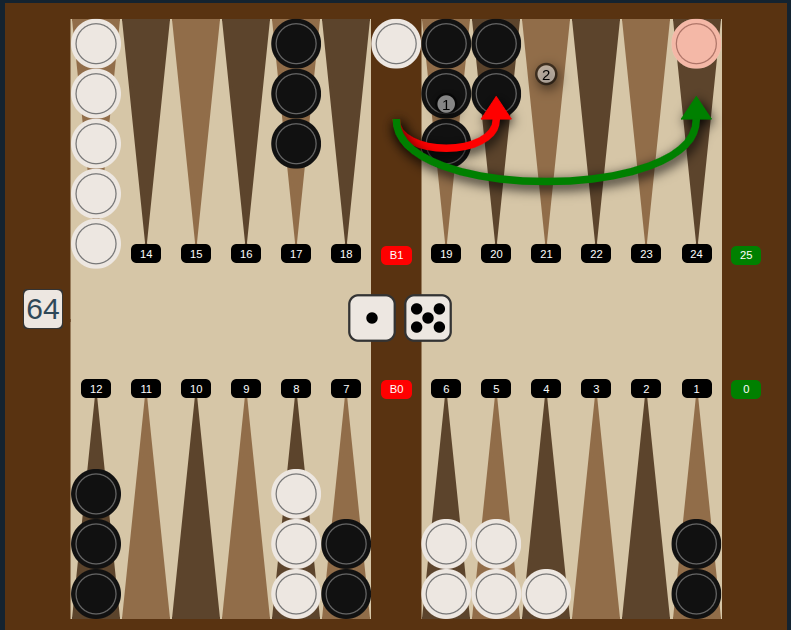
A point occupied by a single checker is called a blot. If you land on your opponent's blot, that checker is hit and placed on the bar.
A player with checkers on the bar must bring them back into play before making any other move. To re-enter, you roll the dice and place the checker on the corresponding point in the opponent's home board.
For example, if you roll a 4, you enter on point 21 (the opponent's 4-point). If both entry points are blocked, you lose your turn.
Hitting is a crucial strategic element — sending your opponent's checker to the bar can gain you significant tempo.
Bearing Off
Once all 15 of your checkers are in your home board (points 1–6), you can begin bearing off.
To bear off a checker, you roll a number that corresponds to the point where a checker sits. For example, rolling a 5 lets you remove a checker from point 5.
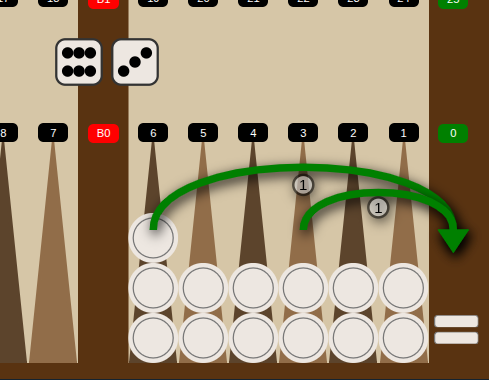
If you roll a number higher than your highest occupied point, you can bear off from the highest occupied point. For example, if your highest checker is on point 3 and you roll a 6, you can bear off from point 3.
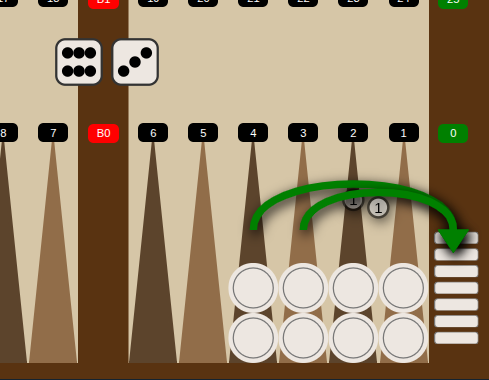
If a checker is hit during bearing off, you must bring it back to your home board before continuing to bear off.
The first player to bear off all 15 checkers wins the game!
The Doubling Cube
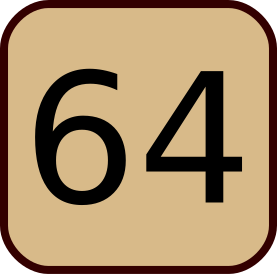
The doubling cube is a die with the numbers 2, 4, 8, 16, 32, and 64 on its faces. It's used to raise the stakes during a game.
At the start of your turn (before rolling), you can propose to double the stakes. Your opponent can accept (take) or decline (drop). If they drop, they lose the game at the current stake.
The cube adds a layer of strategic depth to the game. Knowing when to double and when to take or drop is one of the most important skills in competitive backgammon.
Scoring: Gammon and Backgammon
A regular win is worth 1 point (times the cube value). But there are bonus wins:
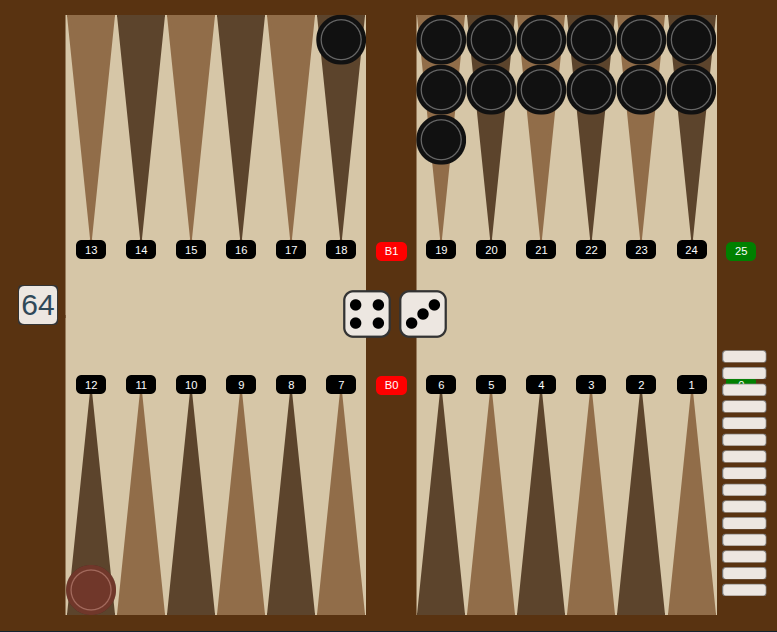
Gammon: If you bear off all your checkers while your opponent hasn't borne off any, you win a gammon — worth 2 points.
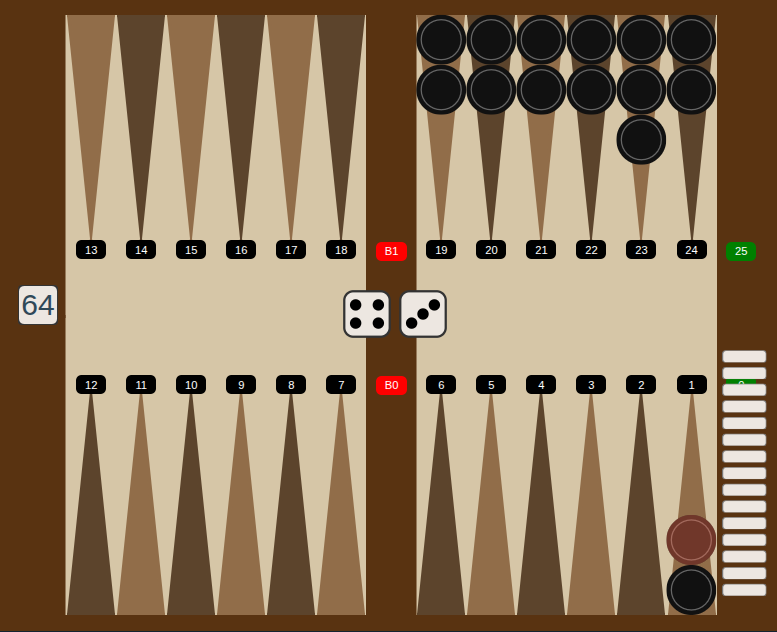
Backgammon: If you bear off all your checkers while your opponent hasn't borne off any AND still has checkers on the bar or in your home board, you win a backgammon — worth 3 points.
What's Next? Try Abak Evolution!
Now that you know how to play classic backgammon, you're ready to explore Abak Evolution — a variant that adds classes of checkers to the game, each with unique abilities.
Abak keeps all the rules of classic backgammon but adds Generals, Druids, Guards, and Wounded soldiers. It's like backgammon evolved.
Play for free at abak.me and discover a new dimension of strategic depth.
Ready to play? Try Abak Evolution for free!