

















This is a comprehensive reference for the official rules of backgammon. Whether you are settling a dispute or learning the game for the first time, this guide covers every rule you need to know.
Game Overview
Backgammon is a two-player board game played on a board consisting of 24 narrow triangles called points. The triangles alternate in color and are grouped into four quadrants.
Each player has 15 checkers of their own color. The game also uses a pair of standard six-sided dice, optional doubling cube, and dice cups.
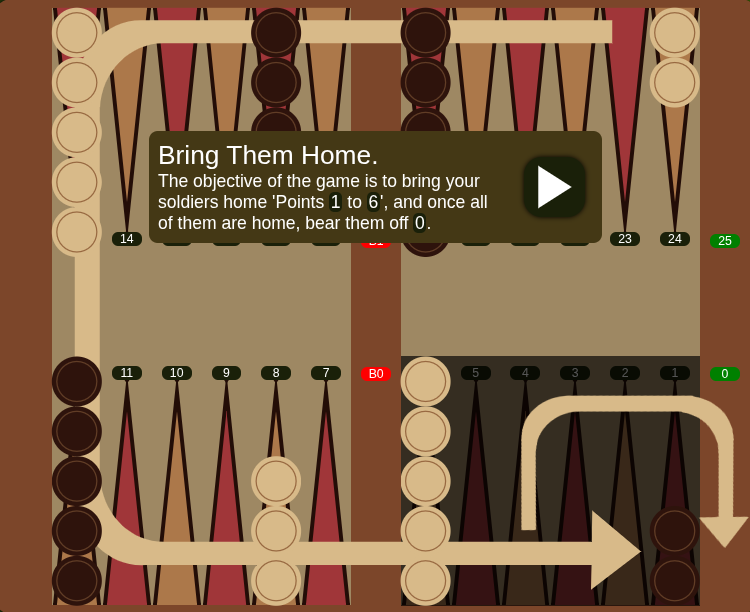
The objective of the game is to move all of your checkers into your home board and then bear them off. The first player to bear off all of their checkers wins the game.
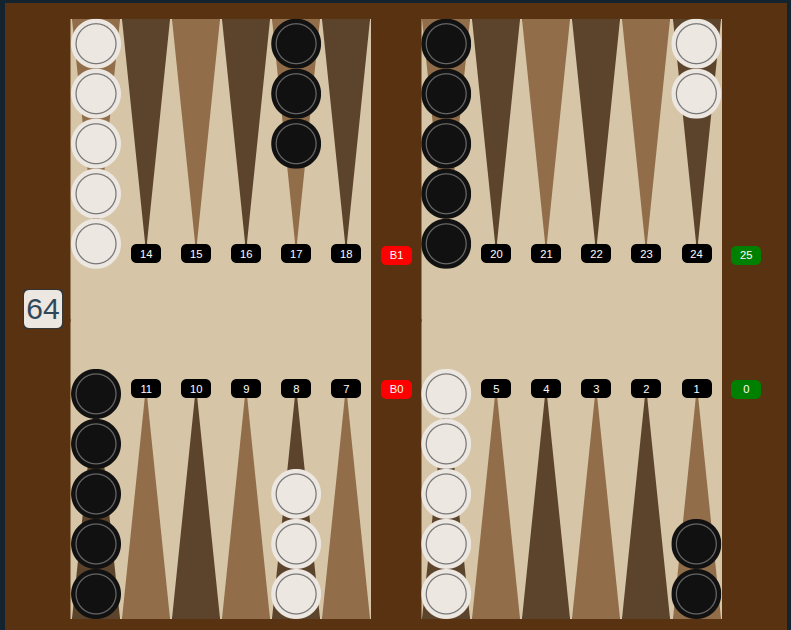
Board Layout and Point Numbering
The 24 points are divided into four quadrants:
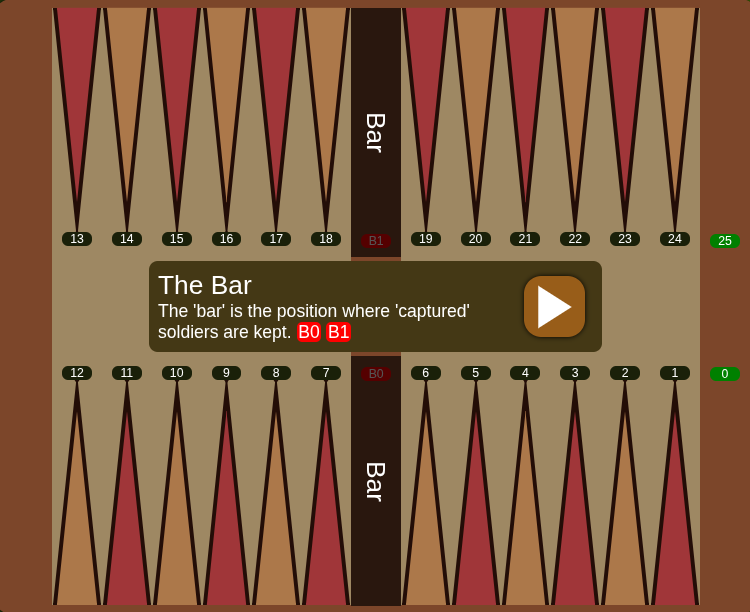
The home boards are opposite each other. The bar — a raised ridge running down the center of the board — separates the home boards from the outer boards.
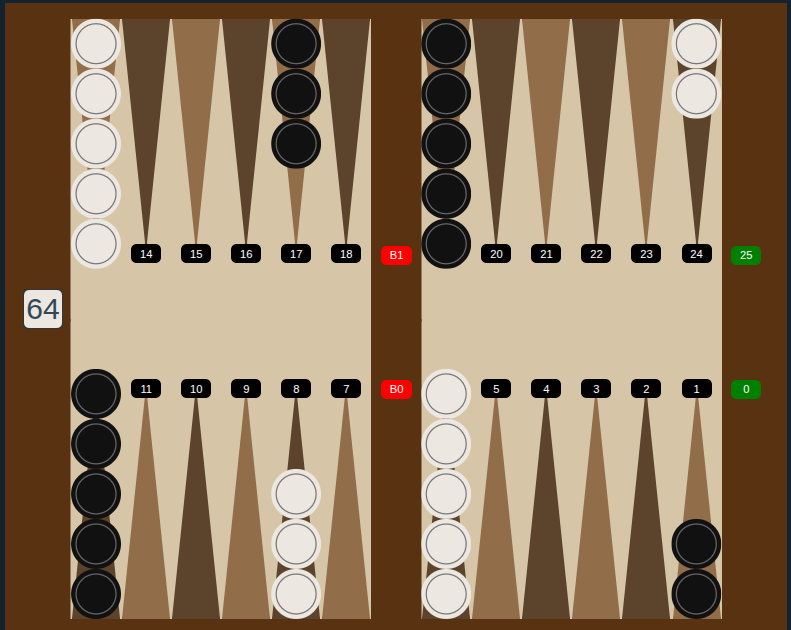
Point 1 for one player is Point 24 for the other, and so on. The numbering always runs in the direction of the player's movement.
Initial Position of Checkers
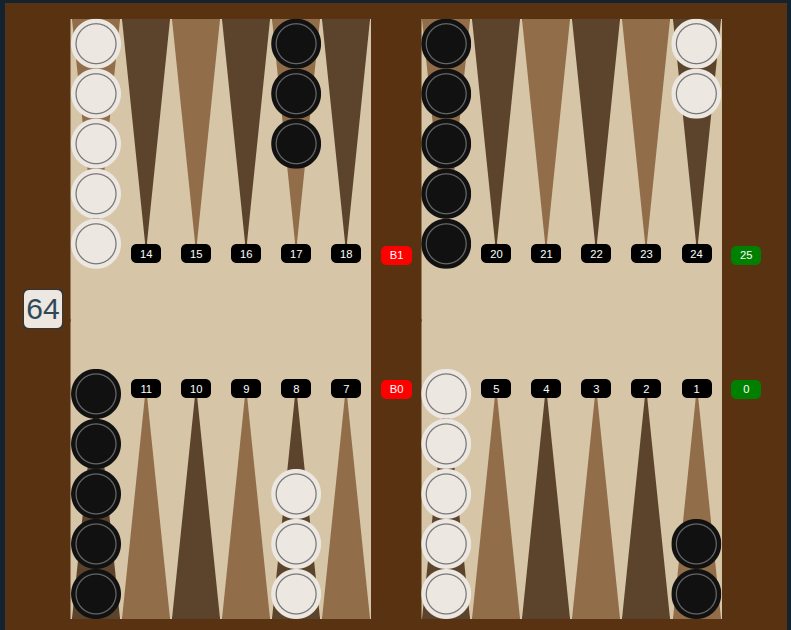
Each player sets up their 15 checkers as follows:
- 2 — Two checkers on the 24-point
- 5 — Five checkers on the 13-point
- 3 — Three checkers on the 8-point
- 5 — Five checkers on the 6-point
The opponent's setup is the mirror image of yours.
Starting the Game
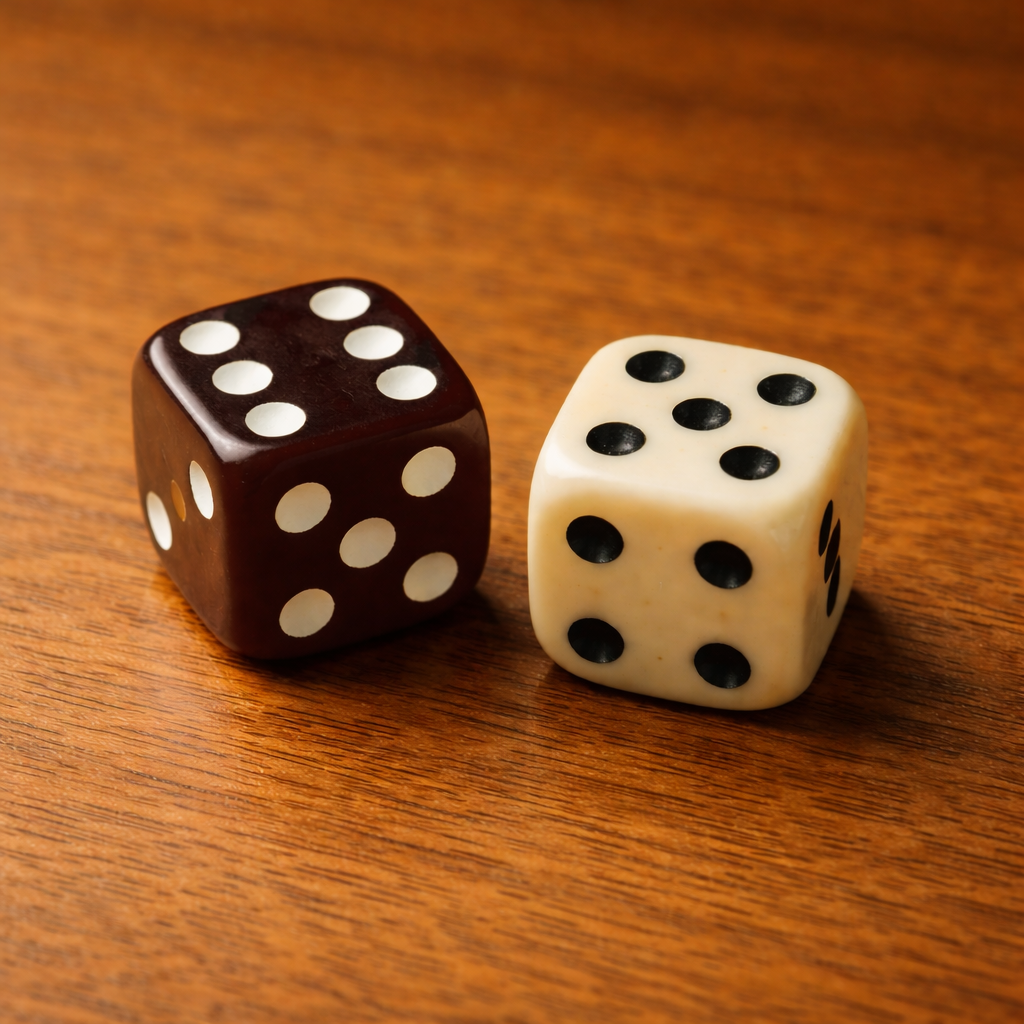
Each player rolls one die. The player with the higher number goes first, using the numbers shown on both dice for their first move.
If both players roll the same number, they roll again until different numbers appear.
After the first turn, each player rolls two dice at the start of their turn.
Movement Rules
The roll of the dice indicates how many points a player may move their checkers. The following rules apply:
Checkers are always moved forward, toward the player's home board.
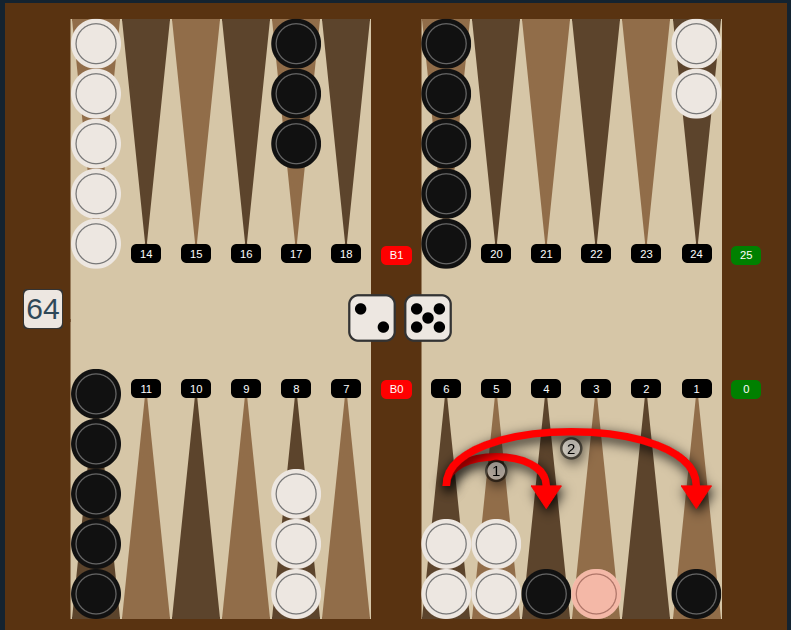
The numbers on the two dice constitute separate moves. A player may move one checker the sum of the dice, or two checkers, one for each die.
A checker may only land on an open point — one not occupied by two or more opposing checkers.
A player who rolls doubles plays the number shown four times.
A player must use both numbers if legally possible. If only one can be played, the higher number must be used. If neither can be played, the turn is lost.
Hitting
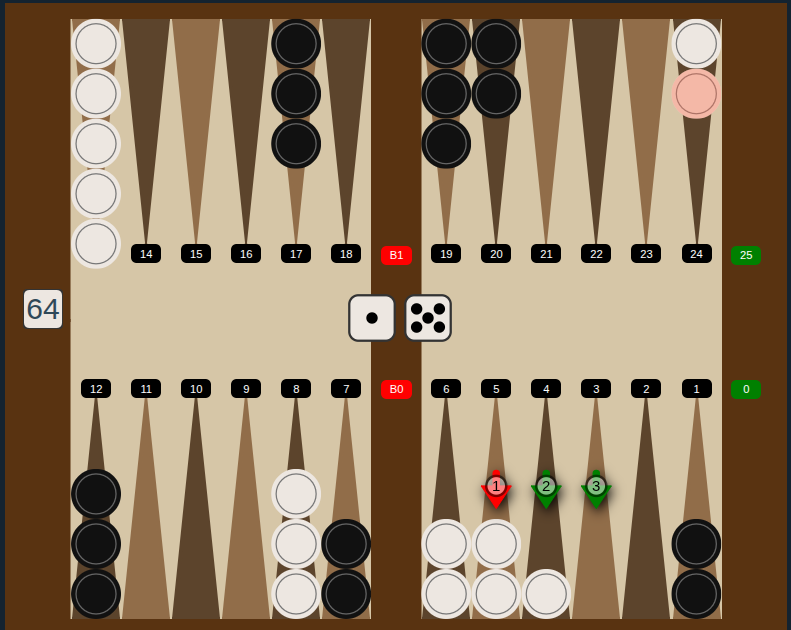
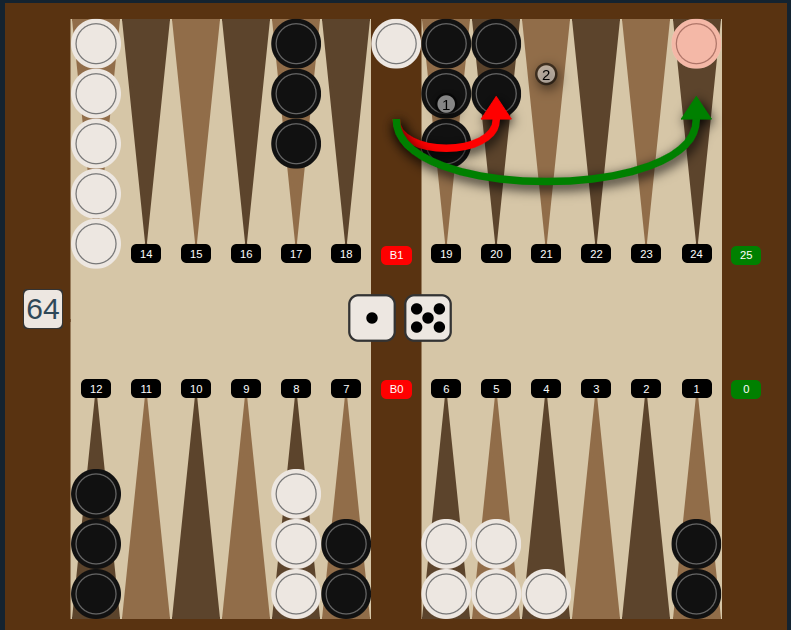
A point occupied by a single opposing checker (a blot) is vulnerable. If you land on a blot, the opposing checker is removed from the point and placed on the bar.
Any time a player has one or more checkers on the bar, their first obligation is to re-enter those checkers into the opposing home board.
A checker is entered on a point corresponding to the number rolled. For example, a roll of 2 allows entry on the opponent's 2-point (point 23).
Closed Board
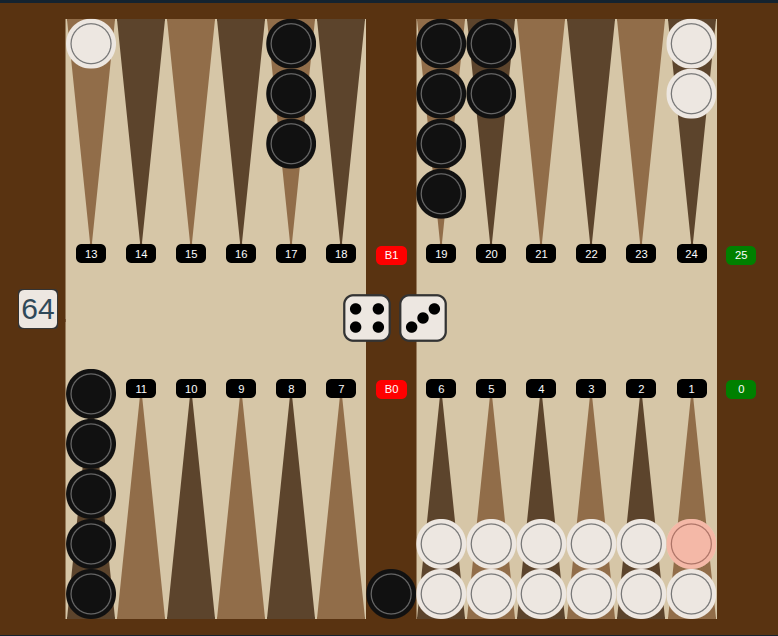
If all six points in the opponent's home board are blocked (occupied by two or more of the opponent's checkers), the captured player cannot enter and loses their turn.
This situation, called a 'closed board' or 'prime', is one of the most powerful positions in backgammon.
Bearing Off Rules
Once a player has moved all 15 of their checkers to their home board, they may begin bearing off.
A player bears off a checker by rolling a number that corresponds to the point on which the checker resides. For example, rolling a 6 permits bearing off from the 6-point.
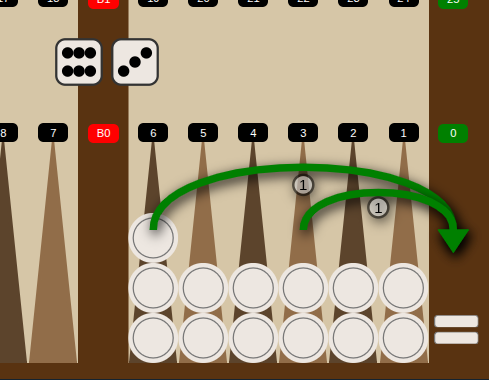
If there is no checker on the point indicated by the roll, the player must make a legal move with a checker on a higher-numbered point.
If there are no checkers on higher-numbered points, the player must (and may) bear off a checker from the highest occupied point.
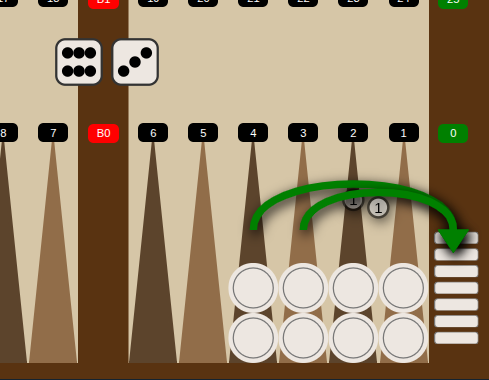
If a checker is hit during the bearing off process, the player must re-enter that checker and bring it back to the home board before continuing to bear off.
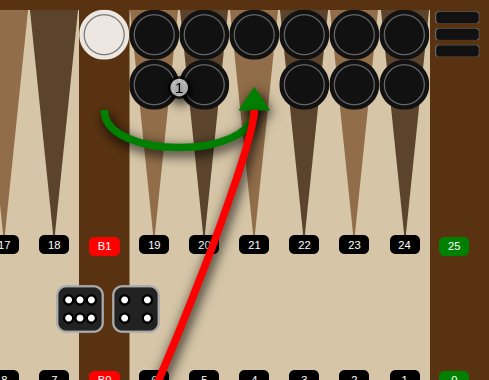
Gammon and Backgammon
Single (×1)
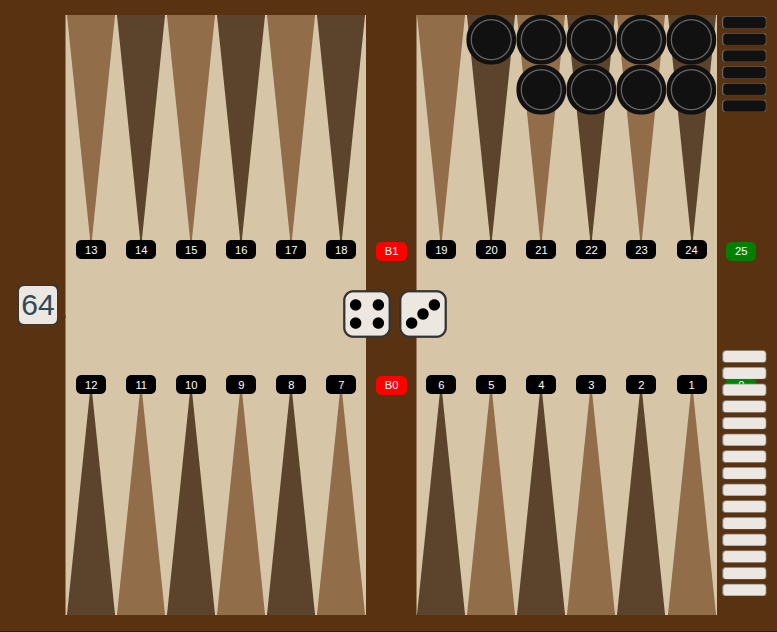
At the end of a game, if the losing player has borne off at least one checker, they lose only the value showing on the doubling cube (or 1 if the cube has not been used). This is a single game.
Gammon (×2)
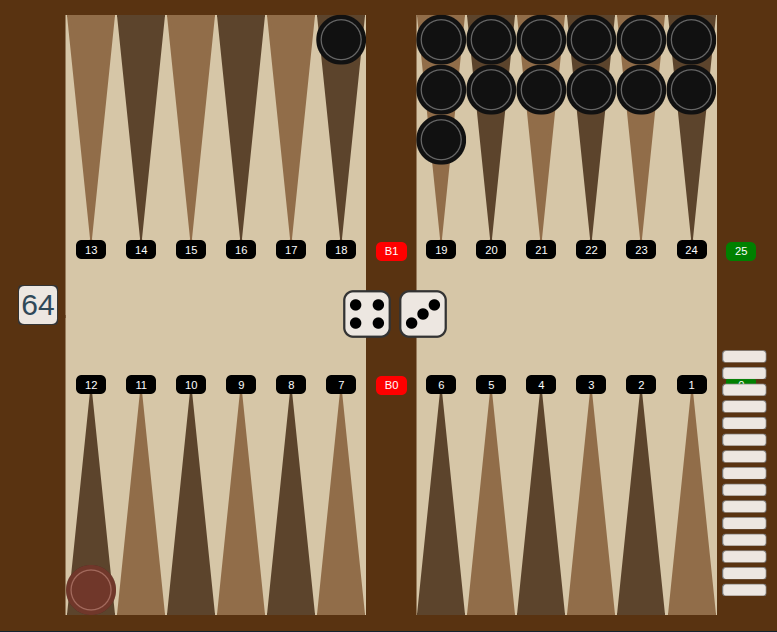
If the losing player has NOT borne off any checkers, they are gammoned and lose twice the value of the doubling cube.
Backgammon (×3)
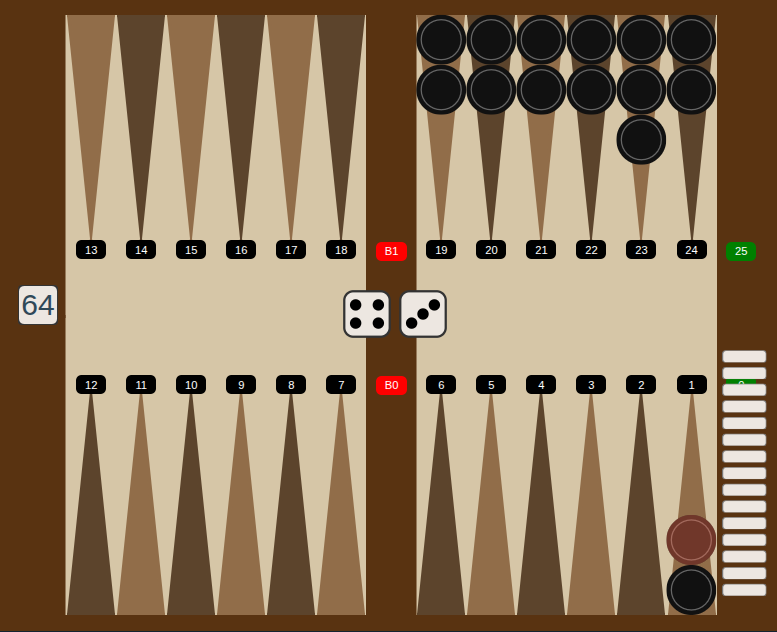
If the losing player has NOT borne off any checkers AND still has a checker on the bar or in the winner's home board, they are backgammoned and lose three times the value of the doubling cube.
The Doubling Cube
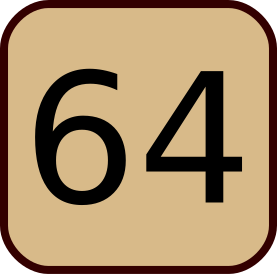
The doubling cube is used to track the current stakes of the game. It starts in the middle with the number 64 facing up (representing a stake of 1).
At the start of a player's turn, before rolling, that player may propose to double the stakes. The opponent must either accept (take) or refuse (drop).
If the opponent drops, they immediately lose the game at the current stake. If they take, the game continues at twice the previous stake, and the opponent now owns the cube — only they can propose the next double.
The cube can be doubled multiple times in a game: 1 → 2 → 4 → 8 → 16 → 32 → 64.
Optional and House Rules
Several optional rules exist in backgammon:
Jacoby Rule
A gammon or backgammon counts only as a single game if neither player has offered a double during the game. This speeds up play.
Crawford Rule
In match play, if one player is one point away from winning the match, the doubling cube may not be used in the next game.
Beaver
If a player is doubled, they may immediately redouble (beaver) while retaining possession of the cube.
Automatic Doubles
If both players roll the same number on the opening roll, the doubling cube is turned to 2.
Want a deeper challenge? Abak Evolution adds classes of checkers to these rules.